Note-A-Rific: Fission & Fusion
Nuclear Energy
Start talking to someone about nuclear energy, and they’ll probably think of two things: nuclear bombs, and the towers of a nuclear power plant (like on the Simpsons!). Most people view nuclear energy as something to be afraid of, but like most things, once you understand it a lot of the fear disappears.
There are two main types of nuclear reactions that can be discussed:
Fission: The process of causing a larger atom to split into multiple smaller atoms, releasing energy in the process.
· This is the system that we use in nuclear power plants.
· It is relatively easy to do, but also leaves us with lots of nuclear waste that must be stored safely for thousands of years.
Fusion: The process of causing smaller atoms to fuse together into a larger atom, in the process releasing energy.
· This is the process that drives our sun, and all other suns.
· We can do it under the right conditions in a lab, but we end up putting in more energy than we get out.
· The left over products of these reactions are safe, which is why a lot of research is going into developing fusion reactors.
We’ll be spending some time looking at the details of both of these processes.
Fission
The most typical fuel used in a fission reactor is Uranium-235.
· In 1939 four German scientists discovered that Uranium-235 would become very unstable if it gained an extra neutron (forming Uranium-236.
· Uranium-236 was so unstable that a fraction of a second later it will split to form two smaller atoms, and in the process release energy.
Here are two common reactions that happen…

and

Some things to notice…
1. Both reactions start the same when we add a single neutron to Uranium-235, which form Uranium-236 for a split second.
2. Barium-141, Krypton-92, Xenon-140, and Strontium-94 are the smaller atoms that Uranium-236 could split into.
3. At any point in the reaction the total numbers of protons and neucleons stay the same.
4. In the first reaction 3 neutrons were ejected, in the second reaction only 2 were ejected. Although it is possible for as many as 5 neutrons to be ejected in some fission reactions, on average it is about 2.5 neutrons.
5. These reactions are exothermic (they release energy).
The basic reaction is written out as…

* X and Y represent any of the smaller atoms that Uranium-236 will split into.
To keep this reaction going, do we need to keep on adding neutrons?
· Well, we could, but it takes energy to isolate them and then throw them at the Uranium-235, so this isn’t the best idea.
· We do have an average of 2.5 neutrons thrown off each reaction, why not just use those?
That’s exactly what we do!
· If exactly one neutron gives rise to another reaction, the self sustaining reaction that results is called “critical”. Each reaction leads to one reaction afterwards. This is a “chain reaction”.
Reaction 1è

One neutron from Reaction 1 feeds Reaction 2, while 1.5 neutrons fly away…
Reaction 2è

One neutron from Reaction 2 feeds Reaction 3, while 1.5 neutrons fly away…
Reaction 3 è

One neutron from Reaction 3 feeds Reaction 4, while 1.5 neutrons fly away…
Reaction 4è

Etc… One reaction causes one more reaction to happen in a row for as long as there is uranium.
· If two or more neutrons give rise to more reactions, the increasing rate of reactions is called “supercritical”. Each reaction leads to multiple reactions afterwards.
|
|
|
|
|
|
|
|
|
|
|
|
|
|
|
|
||
|
|
|
|
|
|
|
||||
|
|
|
|
|
|
|
|
|
||
|
|
|
|
|
||||||


|
|
|
|
|
|
|
|
|
|
|
|
|
|
|
|
|
|
|
|
|
|
|
|
|
|
|
|
|
|
|
|
|
|
|
|




You get the idea. If this continues the reaction just gets bigger and more powerful, releasing energy at an exponentially increasing rate. This is what designers want to have happen in a nuclear bomb, while in a nuclear power plant this will eventually result in a meltdown. This is actually a completely normal process when a nuclear reactor is first turned on, since you want it to build up and get going… then you just need to adjust it to a critical reaction so that it will stay steady.
· If less than one neutron gives rise to more reactions, the decreasing rate of reactions is called “subcritical”
For example, lets say you have 4 reactions, but the neutrons from only 3 of them feed later reactions, and of those 3 only 2 continue, then down to 1… the reaction will eventually die out. This is what happens when you shut down a reactor.
Reactors
All reactors that we currently use go through the process outlined above. There were a couple of problems back in the 1940’s that needed to be figured out before reactors could work.
First
The 2.5 neutrons released in the fission process are moving really fast, in fact too fast to be able to be absorbed by the next Uranium-235 in the chain.
· We need to be able to slow them down. Something that slows down neutrons in a reactor is called a moderator.
· If you want something to slow you should hit it against something about the same size, so it would be best if we could get these fast moving neutrons to hit some other slow moving neutrons.
· Unfortunately, naturally occurring neutrons are very unstable, so we’d be better off with something about the same size as neutrons.
Protons!
· A cheap source of a bunch of protons is water! All those Hydrogen atoms in water are made up of a single proton orbited by an electron.
Second
Hydrogen-1 atoms don’t just slow down neutrons, they can absorb neutrons. This prevents them from going on to the next part of the reaction.
· The reaction that happens is…
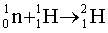
· Water that is made up of Hydrogen-2 is often called heavy water.
· There are three solutions:
1. Use enriched uranium in the reactor.
This just means that the uranium ore is more carefully refined to contain more U-235, so the critical reactions have a better chance of happening.
2. Use heavy water in the reactor.
Rather than starting with regular water, intentionally put heavy water in as your moderator. Hydrogen-2 in the heavy water will not easily absorb any more neutrons. This way you can also use regular uranium ore.
3. Use graphite (carbon) rods.
It turns out this works really well as a moderator. It is a popular method for building reactors in the former Soviet Union and Britain. There is one big problem… if things get too hot in the reactor, carbon can actually burst into flames (they’re basically giant BBQ briquettes). This is what happened at Chernobyl.
The only other thing you should know about reactors is that they use control rods to control the reaction.
· Made with elements such as boron and cadmium, control rods are very good at absorbing neutrons.
· If a reaction is going supercritical, drop the control rods further into the core to absorb extra neutrons and the reaction slows.
· If the reaction is going subcritical, pull the control rods out further, which lets more neutrons react and get the chain reaction going again.
Fusion
Nuclear fusion can result when atoms or subatomic particles combine.
Example: Proton + Neutron à
Mass of p+ = 1.00782 amu
Mass of n0 = 1.00866 amu
Mass of  =
2.01410 amu
=
2.01410 amu
Add them up and you’ll find the total mass on the left is more than the total mass on the right!
This mass didn’t disappear, it was turned into energy according to Einstein’s formula E = mc2 .
In the above example the difference in mass (called the “mass defect”) is…
2.01410 – (1.00782 + 1.00866) = 0.00238 amu
= 3.95 x 10⁻³⁰ kg
The energy released would be…
E = mc2
= 3.95 x 10⁻³⁰ kg (3.00 x 10⁸ m/s)2
E = 3.56 x 10⁻¹³ J
· This may not seem like a lot of energy, but remember that it came from the fusion of just one proton and neutron. If we could trillions of these reactions going every second the release of energy would be impressive!
· Also, notice what the product is… not highly radioactive elements like in a fission reaction… here we get good old hydrogen!
So why don’t we use fusion instead of fission?
- Unfortunately at this stage in our technology we haven’t worked out all the bugs yet.
- We can build and run fusion reactors right now, but we end up putting in more energy than we get out.
- Fusion reactions require intense heat and pressure to allow fusion to happen.
- There is a great deal of research working on “cold fusion”, the ability to cause fusion to happen at lower temperatures.