Note-A-Rific:
Magnetic Fields
We can imagine a magnetic field surrounding a magnet.
· The force one magnet exerts on another is the interaction between one magnetic field and another magnetic field.
· This is why we can have forces without the objects touching, just like the force due to gravity and the force between charges.
To draw magnetic field lines…
- The direction of the magnetic field is tangent to the line at any point
- The field lines point in the direction a north pole of a magnet would point (so, from north to south).
- The number of lines per unit area is proportional to the magnitude of the magnetic field (lines closer together means stronger magnetic field).
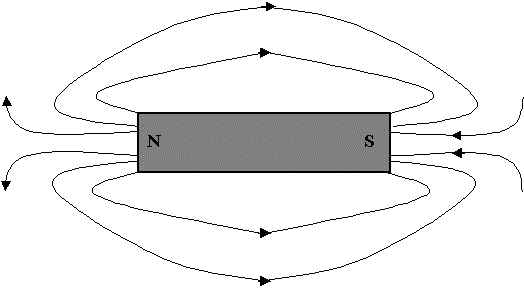
We can define the magnetic field at any point as a vector, represented by the symbol B.
· The direction of the vector is defined as above (from north to south).
· The magnitude is defined in terms of the torque (“twisting force”) exerted on a compass needle when it makes a certain angle with the magnetic field.
· We will use this vague definition for now, but a more precise definition will develop when we start looking at the math behind this stuff.
· The terms “magnetic flux density” and “magnetic induction” are sometimes used for B, rather than the term “magnetic field.”
The earth's magnetic poles are shown here...
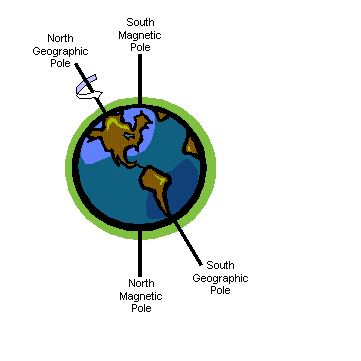
First, notice that the poles are reversed when you compare geographic and magnetic poles.
· At the north (geographic) pole where Santa lives you will find the Earth’s south magnetic pole.
o Remember how we defined the north end of a magnet… we said it points towards the north.
o But that must mean that there is a south end of a magnet up there, since south attracts north.
o Think about it for a few minutes… you’ll see what I mean.
Second, the magnetic poles do not line up with the geographic poles.
· The geographic poles are based on the axis that the earth spins around.
· The magnetic poles are based on where the poles of earth’s “magnet” are found.
o The magnetic south pole is in northern Canada, about 1500 km from the geographic north pole.
o This must be taken into account when using a compass.
o The angular difference between magnetic south and true (geographical) north is called the magnetic declination. In Canada it’s about 0° to 20°, depending on location.