Note-A-Rific:
AC/DC
By using the model of an electric motor backwards the electric generator was developed.
· A motor converts electrical energy to mechanical energy.
· A generator converts mechanical energy to electrical energy.
There are two main ways that a generator can be built:
1. A
connection goes from the ends of the loops to two separate slip rings (see
diagram on bottom of page 745).
· A brush touches each of the slip rings, so that as they spin they are in constant contact. (notice these are not split rings like in the motor we studied!)
· Just like the situation for a motor, every half turn the direction of the current will reverse in this design.
· Because the current changes from being at a maximum in one direction, to a maximum in the opposite direction over and over again, it’s called an alternating current (AC).
· A graph of the current vs. time for this generator would look like this:
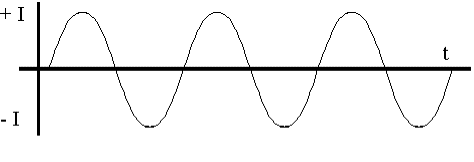
· This diagram show three complete revolutions of the armature.
· Note that the current goes from a maximum going in one direction to a maximum going in the opposite direction.
· Twice every rotation the current actually reaches zero for a spit second!
· If you were measuring this current with an ammeter, you’d see the needle bouncing back and forth all the time.
2. A
connection is made using split ring commutators (see diagram on page 748).
· This type of generator has spit rings like the design of electric motors we looked at a few lessons back.
· When the wires turn so that they are totally vertical, there will be no connection with either split ring… no current.
· When the wires of the armature are exactly perpendicular to the magnetic field (as shown in the diagram) the current leaving the wires is at a maximum.
o The wires are moving the fastest perpendicular to the field.
· As it continues to turn, the opposite split rings will touch the brushes, so current is always in the same direction.
o This is a direct current (DC).
The graph of the current vs. time would look like this…

· Although the current goes down to zero sometimes, the current never goes in the opposite direction!
· Since a direct current that fluctuates this much isn’t very useful, put several different armatures in the same generator, all a slight turn ahead of the previous one.
o This way at least one armature is always putting out maximum current.
o The current then looks more like…

…which closely matches the DC current you get from a battery.
In the late 1800’s there was a great debate on which system, AC or DC, should become the standard for delivering electricity to people.
· Thomas Edison (with personal power and a fortune) believed in a DC system.
· Nikola Tesla (who had sold his entire system to Westinghouse) believed in the AC system.
A demonstration at the World Columbian Exposition in Chicago (1893) showed that AC had one distinct advantage over DC.
· When you deliver electricity over long distance through power lines, you must be careful about the lost power.
o A company that sells electricity is just like any company… they don’t want to lose their product on the way to the customer.
· Do you lose much electricity when it is sent through power lines at the standard household voltage of 120 V?
o This is important, since not many people want to live next door to a power plant, so you need to build them far away from people.
Example: How much power is lost by sending 10 kW of power along a 1.0 W wire at a voltage of 120 V?
First, calculate the current in the wire…
P = IV
I = P/V
= (10 000 W) / (120 V)
I = 83.3 A
Now calculate the power dissipated (lost as heat) in the wire…
P = I2 R
= (83.3A)2 1.0W
P = 6.94 x 10³ W
So, of the 10 000 W you originally sent out from the power plant, 6 940W is lost as waste heat given off in the power lines before it gets to the customer.
In real life the loss would be even greater since power lines have much higher resistances than 1.0 W.
This is a power loss of over 69%!!! Unacceptable!!!
· If any business was willing to lose 69% of its inventory, it would quickly go out of business.
· So how can you minimize the power lost?
o You need to lower the current in the second formula since it is being squared.
· How do you do that?
o Raise the voltage in the first formula, since then the current will drop.
Example: Do the same example as above, but now send the electricity at 2000 V.
First, calculate the current in the wire…
P = IV
I = P/V
= (10 000 W) / (2000 V)
I = 5.0 A
Now calculate the power dissipated (lost as heat) in the wire…
P = I2 R
= (5 A)2 1.0W
P = 25 W
A power loss of less than 1%!!! Fantastic!
Here’s the problem. That voltage is far too high for use in a home.
· We need a way to increase the voltage when it leaves the power station, then decrease it when it gets to a person’s home.
The solution devised by Tesla (and shown at the World Columbian Exposition of 1893) was to use a transformer with his AC power system.
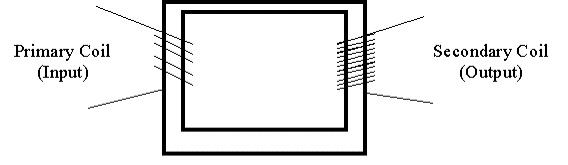
· Start with an AC current running through the wires in the primary coil.
· This will act like an electromagnet, but since it is an AC current, the magnetic field will be changing in the iron ring.
· The changing magnetic field induces a current in the secondary coil.
· Because of the different number of windings (turns of wire) in the primary and secondary coil, you can…
1. Increase the voltage output (Step Up Transformer)
2. Decrease the voltage output (Step Down Transformer)
Follows a very simple formula.
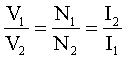
· It represents a set of ratios between the voltage (V), currents (I), and number of windings (N) in the primary (1) and secondary (2) coils.
Example: To save money by preventing power loss in the lines, the power company sends out electricity at 3450V. I need the standard 120V in my home and the power company is using a transformer that has a secondary coil with 200 windings. How many windings should the primary coil have?
· This formula is sort of like Snell’s Law from Physics 20. You only use the two terms you need and ignore the third.
· In this case I already have the two voltages and one of the windings, so I’ll set it up like this…


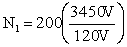
N1 = 5750 windings
Because the AC system could guarantee low levels of power loss over long distances, it became the world standard.
· The only difference is that some countries do use different voltages coming out of the outlets in their homes.
· In North America the standard is 120V.
· If you’re ever on the edge of the west side of Edmonton, check out the large, high tension, high voltage power lines coming into the city.
· The voltage in these lines is extremely high.
o In fact, on a dark night, away from city lights, you can hold a fluorescent tube under these lines and you’ll see it glow!
o A great deal of research has gone into the effects of the strong electric field given off around these power lines.
o Some research has pointed out that there might be an increase in cancer cases near them.
There is one last quirk of AC power systems.
· Remember how the current went one direction, then another, every so often even hitting zero…
· Well, because of this, 120V is a measure of the maximum voltage when the current reaches its maximums.
· Since we have to take into account all the other values it has as it bounces back and forth, we can calculate the effective voltage and effective current that we “truly” get from any AC system.
o Please note that you will rarely need to calculate these values. To be quite honest, we usually ignore this in problems, but you do need to know about it.
Veff = 0.707 Vmax and
Ieff = 0.707 Imax
max à the maximum voltage or current
eff à the effective (sort of average) that you really get