Note-A-Rific:
Induction
So far we know that electricity and magnetism are related in at least two ways:
- An
electric current produces a magnetic field.
- A
magnetic field exerts a force on moving electric charges.
Both of these facts were
discovered between 1820-1821.
· Because of this, scientists began to wonder if a magnetic field could be used in some way to produce an electric current.
- By
1831 the American Joseph Henry and the Englishman Michael Faraday
independently showed it could happen.
- Henry discovered it first, but Faraday published his results first.
- One of the “rules” in science is that it doesn’t matter who actually discovered something first, it matters who got published in a scientific journal first.
- It sort of counts as being “registered” as the creator of that idea.
- You’ve probably never seen one of these scientific journals, since they are read mostly by people like university professors.
The design Faraday came up with was like this…
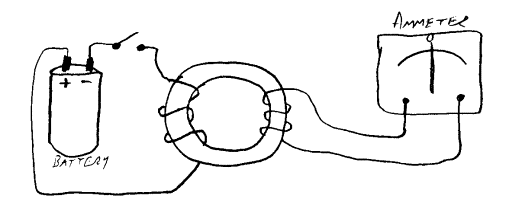
When the switch on the battery is closed:
- Current will flow through the battery.
- Since it is wrapped around an iron ring, this wire will act as an electromagnet.
- Faraday (hoped) that the magnetic field in the iron ring would go all the way around to the other loops of wire and create an electrical current that he could measure on his ammeter.
Faraday never saw the needle move on the ammeter when he ran a steady current from the battery.
- He did notice that when he first switched the battery on, the
needle went one way for a moment.
- The needle went the other way for a moment when the battery was
shut off.
- Faraday figured out that a changing
magnetic field could produce a current.
- Such a current is called an induced current.
Faraday performed other
experiments on electromagnetic induction (the name of this process).
- As the following diagrams show, as a magnet is moved quickly
into or out of a coil of wire, a current is induced.
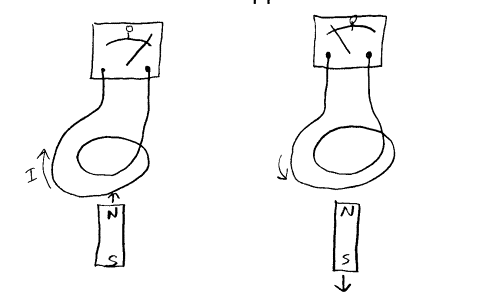
- This showed that it is a changing magnetic field that was creating the current, since the magnetic field would get stronger as the magnet was shoved in, and weaker as it was pulled out.
- This might sound like your creating energy out of nothing.
- That would break the laws of thermodynamics.
- Instead, you have to remember that you need to use some source of energy (like your muscles!) to move that magnet in and out of the coil of wire.
- You actually do feel resistance as you try to do this when current flows in the wires.
You can also generate electricity if you push a length of wire through a magnetic field, so that the wire is moved perpendicular to the magnetic field.
· Use the 3rd left hand rule (force on negative moving charges) to figure out the induced electron flow current in the wire.
- Fingers point north to south in the direction of the magnetic field as always.
- Your thumb points in direction of wire’s motion, since that is the direction that the electrons that are in the wire are moving.
- Your palm points in direction of the force acting on those charges, which tells you which way they are going to be pushed... the direction of the current flow!
Example: Using the following diagram, determine which way the current is flowing.
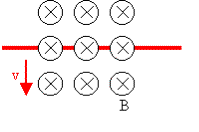
The magnetic field is pointing into the page,
so my fingers point into the page.
The wire is moving downwards, so my thumb
points down.
My palm is facing left, so the electrons will
experience a force pushing them to the left. The electron flow current is to
the left.