Historically, we have reached a changing point in Physics.
- Up to about this time people that studied science tended to be rich, bored, upper class that did it as a hobby.
- Around the time of Galileo this started to change.
- More and more people were starting to study science as a career.
- They also started setting up what we would today think of as basic research labs.
- In this section we look at two people that were doing there work during these changing times, and neither of them fit perfectly into these two categories, but both of them had elements of this change in them.
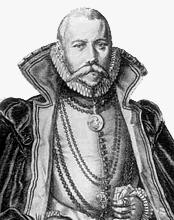
Tycho Brahe (1546 – 1601)
Born in modern day Sweden, Tycho Brahe was not satisfied with the imperfections he saw in the measurements of stars and planets.
- Most where in fact from a book written by an ancient Greek named Ptolemy about 1400 years earlier!
- Brahe was sure that he could do better calculations.
- To finance an observatory Brahe became buddy-buddy with Frederick II, King of Denmark!
- Frederick II liked Brahe’s ideas so much that he gave him an entire island called Hven off the coast of Denmark. That way Brahe would be away from all the bright city lights.
- He also gave Brahe the money to build the observatory on the island, which was named Uraniborg ("Fortress of the Heavens").
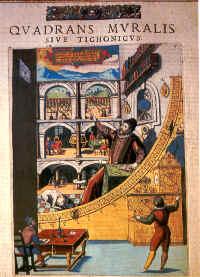
Uraniborg
Brahe spent the next twenty years making observations from this location that were more precise and detailed than any that had ever been done before.
- Finally, Frederick II died and Brahe couldn’t convince the new king to support his work. Uranienborg was shut down and Brahe moved away to live near Prague.
- Before he could finish building a new observatory Brahe died.
Brahe was one of the new types of careful, professional scientists that were starting to appear.
- Unfortunately, he wasn’t very good at coming up with theories.
- He was basically a careful observer with books of collected data that he didn’t know what to do with.
He also had a rather interesting life…
- On one occasion he had an argument with another person over a mathematical formula.
- They had a duel and part of Brahe’s nose was cut off (ouch!)
- For the rest of his life he wore an artificial nose made out of copper (yuck!)
- At the very end of his life Brahe was attending a very important dinner party to help raise some money for his new observatory.
- Because his hostess kept talking, he couldn't leave the table to go to the bathroom (this would have been very rude in that society).
- He ruptured his bladder and died several days later.
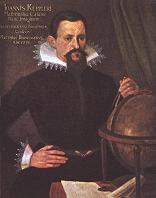
Johannes Kepler (1571 – 1630)
Johannes Kepler came from a very poor family (his dad was a common soldier).
- He was part of the new breed of scientists, people who made it their career to study science.
- Although he still had patrons (rich people that give you money so you’ll do stuff like write “Dedicated to…” in the cover of your next book), he also made money directly from using his knowledge.
Kepler was known for being a little odd.
- He had this way of sort of going into a trance while walking… and he would just keep on walking and walking and walking…
- According to some accounts he once walked into a lake, and once walked clear over to a neighboring town.
- He also had a theory about the planets being attached to crystal spheres and that if you listened carefully you could hear them hum as they moved.
Some modern day researchers and doctors believe that Kepler's "trances" may have been caused by some form of epileptic seizures, and the sounds he heard from the "crystal spheres" were caused by a hearing disorder called tinnitus.
Kepler was also known for his way of coming up with scientific theories… come up with a whole bunch, even wacky ones, and eventually you should stumble on the correct one.
- In 1600 he became Brahe’s assistant (just one year before Brahe’s death).
- This was a very fortunate partnership, since Brahe had a lifetime worth of data, and Kepler was good at coming up with theories.
- Although Brahe died a short time later, Kepler still used a great deal of his data to form the basis of his later work.