In our modern world the world “satellite” almost always means a human made object launched into orbit around the Earth for TV or phone communications.
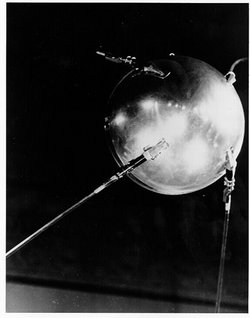
- This definition of satellites has really only been around since around the 1950’s when the Russians launched the first artificial satellite, Sputnik 1, into orbit around the Earth.
- The word satellite actually applies to any object that is in orbit around a (typically) larger object.
- By this definition, the moon is a satellite of the Earth, and the Earth is a satellite of the sun.
- The good news is that basic ideas about satellites can be applied to just about any satellite (with some modifications).
- The basics that you will learn here are the same general ideas that NASA and other space organizations use when launching artificial satellites into orbit, or studying natural satellites.
Newton’s Cannon
Yep, Newton again! We need to talk about Newton for about the third time in this course, but this should give you an idea of just how much stuff he studied and what a large impact he had on physics.
Newton came up with what seems like a very strange idea.
- He asked the question “What would happen if we put cannon on a mountain top and shot a cannonball horizontally out of it faster and faster?”
- From our study of projectile motion, we know that the cannonball will travel a further horizontal distance, but will take the same amount of time to hit the ground.
- This is assuming we are on totally flat ground, which would look like Figure 1 …

Newton knew the Earth is a sphere and therefore has a curved surface.
- As the ball travels horizontally, the Earth curves away from the straight horizontal. On the Earth, the diagram would look like Figure 2 …
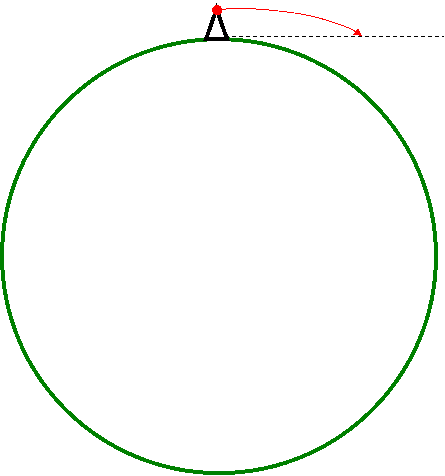
Notice how the red line of the path of the projectile matches the green curve of the Earth.
- As the projectile curves downward, the Earth’s surface drops away. If this continued, the object would never hit the ground!!!
- In theory, it would go all the way around the Earth and hit the cannon from behind.
Newton wanted to know how fast the object would need to move horizontally to follow this orbital path.

- If an object moves roughly 8km horizontally, the Earth curves down by 4.9m.
- The reason 4.9m is important is because that is the distance that an object will fall down in one second in regular Earth gravity.
- That way the curve of the projectile will exactly match the curve of the Earth.
That would mean that the projectile needs to be shot out of the cannon with an initial horizontal velocity of 8 km/s.
- That might not seem like much, but look at it this way…
- 8km/s = 8000m/s = 28 800 km/h
- That’s pretty fast!
Newton understood that it was physically impossible to build a cannon that powerful.
- He also knew that even if someone figured out how to move something that fast, air resistance would cause it to burn up.
- That is why we have to launch stuff into orbit pretty high up, to get out of most of the Earth’s atmosphere.
You can take this idea of satellites a little further to calculate some stuff about either the planet or the satellites.
- Since the satellite is in a more or less circular orbit, the force acting on it must be…

where “m” is the mass of the satellite
- We also know that it must be gravity that keeps the satellite from spinning out into space, so…

where “M” is the mass of whatever is being orbited, like the Earth
- We make the two equal to each other and cancel out…


- With this formula we can calculate the velocity of a satellite at a particular distance from the centre of the Earth.
Example 1: Determine how fast a 28.5kg satellite moves if it is orbiting the Earth at 120km above the surface.
Remember, the mass of the satellite doesn’t matter. Also, you need to measure the distance from the centre of the Earth, so look up the values for the radius of the Earth (and its mass) on the back of your data sheet.
r = 120 000m + 6.37x10⁶m = 6.49x10⁶m
M = 5.98x1024kg
v = 7.83e3 m/s

You could also arrange the formula from above to figure out the mass of the object being orbited.
Example 2: We send a probe to orbit a nearby asteroid and take some pictures of it. The probe enters an orbit that puts it 850m from the centre of the asteroid. If the probe moves at 12m/s, determine the mass of the asteroid.
M = 1.8e15 kg