Remember in the last section we found that a single slit could produce interference fringes… just not very well.
- A double slit apparatus like the one that Young used worked better and gave clearer images of the fringes.
- If one is good, and two is better, a bunch would probably be fantastic!
This was an idea that some physicists thought of after Young’s work had been published.
- Was there a way to make an apparatus like his that had a lot of slits in the first screen…
- Now, when I say a lot of slits, I really do mean a lot. These guys wanted to figure out a way to have hundreds, or thousands of slits, cut into the screen.
- They figured that this would produce incredibly sharp interference fringes that they would be able to measure even more accurately than those in Young’s experiment, which would allow them to measure the wavelengths of light even more carefully.
The problem was, how could you possibly cut that many slits into a screen… you simply can’t.
- Their solution was to look at things a little differently.
- Have you ever been driving in a car that had a big crack in the windshield? You probably found it was very distracting if the crack was right in front of your eyes.
- This is because light doesn’t travel very well through cracks in glass. In fact, even scratches in glass block the passage of light.
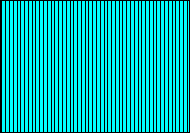 Figure 1: Sketch of parallel
scratches. - The idea these scientists had was to take a piece of glass and cut very narrow parallel scratches into the surface using a diamond (Illustrated in Figure 1).
- These scratches won’t let light through, but light will still be able to pass through the spaces in between… it will be like thousands of little slits cut into a screen!
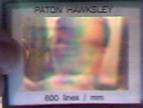
Mr.C as seen through a
diffraction grating.
These became known as diffraction gratings, since they diffracted light though the little gratings cut into them.
- Held up near a source of white light, they will easily split the light up into a rainbow of colors.
- You can also use a monochromatic light and see very distinct bright and dark fringes.
- Using these diffraction gratings it is possible to measure the wavelength of light very accurately, even if the most basic measurements are taken.
The only big drawback to this method is the cost. Using a diamond to cut perfect scratches into a piece of glass takes a lot of time, and you pay for it!
- It was later discovered that if you take a thin sheet of plastic (usually acetate) and press it hard against a real glass diffraction grating, you can make a copy of it and it will work as a decent diffraction grating.
- These replica diffraction gratings are the kind that you usually would use in a high school.
through a replica
diffraction grating.
Although the replica diffraction grating shown in Figure 3 doesn’t appear to be splitting up light into colors, when you are actually looking at it in person you can see faint colors around bright objects.
Whether you are using a true diffraction grating or just a replica, you can still use both of the formulas that we looked at in Young's Double Slit Experiment (Lesson 58)
- What you will have to watch out for is the way that you get the value for "d" to use in the formulas.
You can imagine that the spacings between the scratches are incredibly small.
- Because of this, the traditional way of labeling a diffraction grating is to say how many scratches there are in a certain amount of length on the glass.
- In both Figure 2 and 3 I was using gratings that had spacings of 600 lines/mm.
- It means that you have to do a quick conversion to find "d" for the formula.
- Since "d" is the distance between the groves in metres and we have the number of grooves per millimetre, the first thing we would do is take the inverse.
- Then, since we want metres instead of millimetres, we divide by 1000 (the number of millimetres in one metre).
Example 1: Determine the value of "d" for the true diffraction grating shown in Figure 2 that is labeled as 600 lines/mm.
600 lines / mm >>> take the inverse (use the x-1 button on your calculator)
1 / 600 = 0.00167 mm/line >>> divide by 1000 to get metres
0.00167 ÷ 1000 = 1.67e-6 m/line
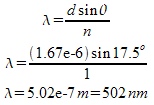
Example 2: Using the value for "d" for the diffraction grating you just calculated, determine the colour of light being used if the angle from the central bright band (fringe) to the first fringe is 17.5°.
Since we weren’t told anything else, we will assume that this is the first bright fringe from centre, so n = 1. Also, make sure your calculator is in degree mode!!!
This is basically green light.
The reason a CD or DVD has a rainbow of colours on it is because the thousands of circular grooves pressed into the aluminum subsurface act as a diffraction grating.